
Standing at a crossroads for wild fish
The following are remarks IRU Executive Director Greg McReynolds gave at the 2026 Sun Valley Forum.

Photo: Neil Ever Osborne
The Idaho you see today is a marvel, but it wasn’t always like this. If you travel east, you will run into the malpais in a place called Craters of the Moon. Craters is recent, geologically speaking—only 20,000 years old. But it will give you a glimpse of the bones of Idaho. Much of Idaho was massive fields of basalt, the leavings of ancient volcanos and magma seeps, where molten rock, sliding just under the surface of the earth, scratched a barren scar across the west from the Sierras to the Rockies.
And then came salmon. The nitrogen and carbon that built the forests that surround us came from salmon. Salmon that roamed the Pacific, gaining strength and weight, and then came home. Millions of salmon for millions of years, so vast in number that their nutrients reside in every tree and blade of grass and insect and animal—and even in us. Salmon have survived drought and flood. They kept coming through four glacial cycles when ocean conditions vacillated dramatically, including a time when the ocean was 100 meters lower than the current sea level.
And in August and September, Chinook salmon will arrive to spawn at the headwaters of the Salmon River, the top end of the last, best salmon habitat left in the lower 48. Historically, they filled the rivers to bursting. Scientists estimate that upwards of 16 million salmon used to swim up the Columbia, with more than half of those returning to their natal waters in Idaho’s Snake Basin. But now, only a handful of wild fish will make it home.
A single redd will stand out in the river like a beacon. A massive female, fanning the gravel into a nest for her eggs.
You might stand in the willows and watch, and the thought of her incredible journey, the hope that it takes to swim 900 miles to the Pacific, spend years roaming it, swim 900 miles home, only to spawn and die—will take your breath away.
The reason salmon runs that once measured in millions are now diminished to a few fish is simple. There are four dams along the lower Snake River in eastern Washington, creating a 140-mile chain of slack water. They allow fish passage, but they are particularly deadly to young salmon migrating downstream. These dams provide barging and some electricity, but they are driving the most important salmon runs in the contiguous United States to extinction.
To tell you how we got here, I want to take you back to March of 1945.
American troops were still fighting in Europe and in the Pacific, but the writing was on the wall. The war would be over in a few months, and Congress was starting to think about what came next. Before the war, the U.S. economy was recovering from the great depression with unemployment still over 20 percent. The American war machine had roared to life on Dec. 8, 1941 and built millions of tanks, guns, planes and ships; but in that period, we had built almost nothing for domestic use.
So, with the need for tanks and planes about to dry up, and with 7 million American service members soon to come home looking for a job, Congress decided it was time to build. With the war still lingering on in March 1945, Congress passed the Rivers and Harbors Act. Among other things, the bill authorized the construction of those four dams to create a chain of flatwater that would extend from the already dammed Columbia River another 450 miles to Lewiston, Idaho.
The legislation aimed to create an inland port and generate electricity. But in truth, the goal was not dams or electricity or ports. The goal was jobs and progress. In 1945, less than half the homes west of the Mississippi River had a telephone. In the Pacific Northwest, most of the roads were dirt. Cities had electricity, but many rural areas were still using oil lamps.
Many of the men and women who built the lower four Snake River dams did not live to see them completed. The project was authorized in 1945 and completed in 1975.
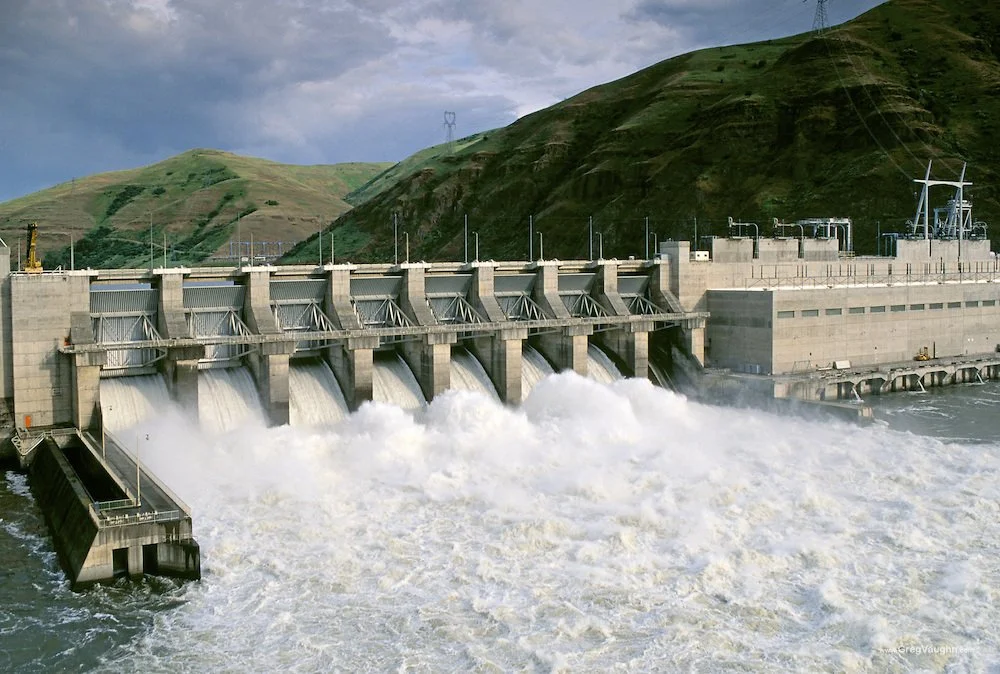
The people who built these dams were immensely proud. They had big dreams. They were building something for the future. They could not see over the horizon line, but they knew they could do better. They were not content to pass oil lamps and dirt roads onto their children and grandchildren. They built massive infrastructure projects. They electrified the northwest.
They did not accept the status quo, and they changed the world in ways that were wonderful— and terrible. The project brought jobs and power and an inland port, but our wild salmon runs began a downward trajectory.
In the 50 years since the completion of the lower four Snake River dams, expectations have continually lowered—year by year, decade by decade, and generation by generation. Until WE arrived. And when one of us catches a wild steelhead in central Idaho or sees a spawning chinook, we are staggered by a single fish.
The Snake River basin is massive. I have absolutely no doubt that if we remove the lower four, wild salmon and steelhead will recover in Idaho. The Snake basin encompasses about 50,000 square miles of land. It contains 30,000 accessible stream miles, the majority of which is protected wilderness or roadless.
And it’s choked off by four dams that create 140 miles of hot, slack water. The gauntlet of the lower four is a literal death trap for salmon and steelhead smolt. Since the completion of the four lower in 1975, our salmon and steelhead populations have declined by more than 90 percent. In the 50 years since the lower four were completed, Snake River salmon and steelhead populations have plummeted despite the $25 billion spent in mitigation by ratepayers.
$25 billion on mitigation, and wild fish continue a downward trajectory. Extinction has already claimed several populations and is assuredly coming for the remaining wild Snake River stocks. And it’s not just the salmon that are struggling. Tribes are struggling. The congressionally authorized treaties, signed in 1855, that guaranteed salmon are being violated. The Tribes’ way of life is being destroyed. Communities that rely on salmon are struggling. Places like Riggins and Salmon, Idaho that used to have thriving economies based around robust returns of salmon are a mere shadow of their true recreational and economic potential.
And even in the heart of the hydro system, the towns of Lewiston, Idaho and Clarkston, Washington are falling behind.
In 1945, the Army Corps of Engineers and the Bonneville Power Administration said they could overcome impacts to salmon with hatchery-focused mitigation; but in reality, salmon were sacrificed for economic progress.
90 years on, we can see that not only did we sacrifice salmon, but the economic boom didn’t last either.
In truth, the economic benefit from the dams came not from their usefulness, but from their construction. A report from Headwaters Economics released earlier this month shows that the economies of Lewiston and Clarkston, the inland port cities, are lagging behind the rest of the state and the region. The population is stagnating. The industries most closely associated with the dams—shipping and agriculture, are declining, while those not reliant on the status quo of the hydro system, are growing.
Meanwhile, the electricity from the dams is decreasing, in volume and in reliability. Long-term drought and needed flows for salmon mitigation and driving down power output. And the heat of summer and coldest parts of winter, when the electricity demand is at its peak, is when low flows reduce the ability to generate meaningful power.
Over the last few years, these four dams have averaged less than 700Mw of electrical output annually. That is less than a single natural gas peaking plant. Less than a medium-sized solar facility. Barely enough to power the largest hyperscale data centers. And certainly smaller than the average new energy project.
This issue is often boiled down to two “political” options:
Keep things the same, while salmon go extinct; or
Put the people who rely on the services of the lower four out of business.
That is not our worldview.
We are invested in the places where we work; we are part of these communities. Idaho Rivers United and our partners are committed not only to removing the dams, but to replacing them with better, modern solutions that will boost our local communities and recover wild runs of salmon.
We buy electricity. We fish these rivers. Our kids go to school in Idaho. And I hope that my children will someday work in Idaho. We live the reality of the region, and we feel the absence of the salmon in a personal way. The Snake Basin is a salmon sanctuary, but it’s a people sanctuary too.
And we are faced with a simple choice, for people. This is a moment not unlike 1945. We are faced with deep uncertainty. The regional economy is hobbled. Our infrastructure is outdated. We can do something. Or we do nothing.
We can just keep trying the same failed tactics of the last 50 years. We can grow hatchery fish to die in the turbines. We can watch the electric output continue to dwindle, even as the department of energy forecasts a doubling in electrical demand over the next two decades.
But the status quo is not benign.
The choice to do nothing is more litigation, reduced flows, more spill, reduced irrigation water and less investment in infrastructure. Doing nothing is clinging to 90-year-old technology, whose value has already peaked, and doubling down on that failing investment.
Doing nothing is a failure to save an iconic fish. And will mean more lawsuits and an escalation of the salmon wars. Lawsuits will multiply, judges will rule, winners will be few.
And eventually the dams will come down. With inaction, they might last another decade or two. They might even outlast Idaho’s salmon, but we all know the lower four won’t last forever.
A couple of years ago, a Republican Congressman, Idaho Representative Mike Simpson – proposed a shift in the way we think about the region and hydro system. In exchange for dam removal, Congressman Simpson proposed that we would give hydro system operators new investments, as well as surety, by protecting other dams in the Columbia system. He proposed a path to salmon recovery that didn’t leave anyone behind. He proposed $150 million for waterfront projects in Lewiston and Clarkston and $14 billion for power replacement projects and $2 billion for transmission upgrades and $1.2 billion in clean water grants and investments for farmers and $4 billion for river transportation.
These are the kind of investments that changed the world 90 years ago. But the window for a grand bargain that invests in the region is closing.
Reduced water is impacting fish and hydro operations and there is a growing acknowledgement, spurred on by the agreements on the Klamath and the removal of Elwa dam, that these dams will come down.
And yet, I am hopeful.
A salmon is hope. A species that spends a million years changing a landscape is the ultimate expression of hope. Idaho salmon swim 900 miles, climb 6,500 feet over 8 dams and through 8 reservoirs, past the pinnipeds and the anglers—twice. Once as a smolt, then if all goes well, as an adult, only to die—and spawn a new generation. As a species, salmon can see beyond the sightline of the horizon. They serve, not themselves, but future generations.
The people who built the lower four dreamt big. We can also dream big. But we cannot double down on these aging dams. We must seize the opportunity of this moment.
Opportunity is what ties us together. It is a shared hope. Opportunity is what lies ahead.
Since the construction of these dams, we have put a man on the moon, landed a probe on another planet and mapped the human genome. We have seen the birth of the internet and artificial intelligence and watched it change the way we work, and live. Our world is fundamentally changed.
The lower four are anchor holding us back. The future is abundant electricity. The future is new modes of transportation. It is creating the kind of jobs that can’t be outsourced or done with AI. The future is once again investing in the infrastructure of tomorrow. The future is abundant salmon in Idaho.
And it’s time to start building.